
What does fluidized mean?
A fluidized bed IQF freezer is a continuous freezing machine designed to freeze small, loose food pieces individually. IQF means Individually Quick Frozen: instead of leaving the freezer as a solid block, each strawberry, pea, diced vegetable or suitable shrimp product can leave as a separate, free-flowing piece.
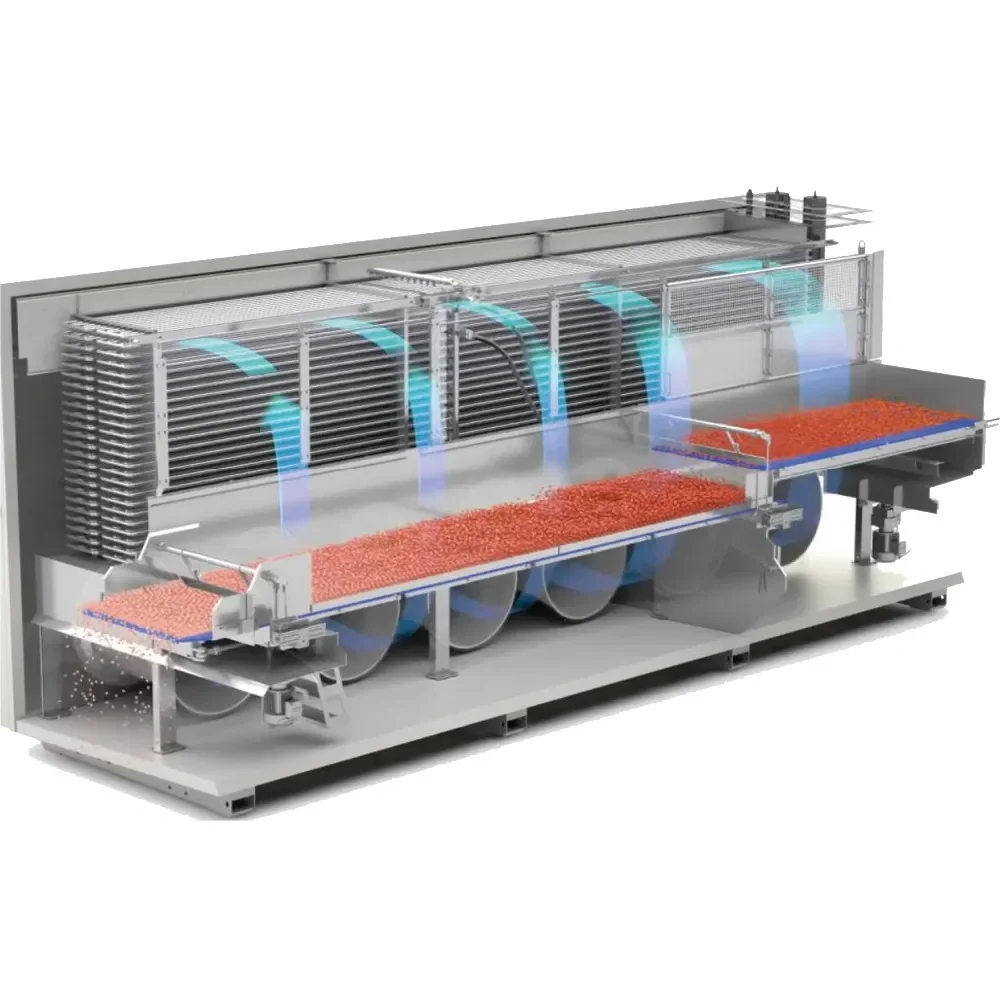
Inside the freezer, fans push cold air upward through a perforated or mesh conveyor belt selected for the product and final configuration. When the airflow is matched to the product, the product layer is lifted and gently agitated. The exact movement depends on piece size, weight, moisture and selected airflow.
The complete freezing process
Preparation strongly affects the result. Product is normally cleaned, drained and cooled before entering the freezer. Removing excess surface water reduces the refrigeration load and can reduce frost on the evaporator. After blanching or cooking, pre-cooling helps stabilize the product condition before freezing.
A vibrating feeder or distribution device spreads the product into an even, shallow layer across the belt. Even distribution is important because a thick pile can reduce airflow penetration, slow freezing and increase adhesion.
In the first section, the product meets cold airflow and rapid surface freezing begins. As the pieces continue through the freezing room, the product reaches the specified target temperature, often around -18 °C at the product core depending on the product and project basis. At discharge, the loose product can move to weighing, packing or cold storage.
Main components inside the freezer
The mesh belt and conveying system carry the product through the freezing room, while belt speed helps control residence time. Fans and air ducts distribute cold air across the belt width. The evaporator removes heat from the circulating air, and the insulated enclosure maintains the low-temperature environment.
Depending on the design, vibration or agitation helps with distribution and separation. A control cabinet manages belt speed, fan operation, temperature and cleaning or defrost sequences. Food-contact structures and cleaning arrangements are selected according to the final project configuration.
- Conveying and product distribution
- Fans, air ducts and evaporator
- Insulated freezing enclosure
- Agitation, cleaning and drainage
- Control and refrigeration package
Which products are suitable?
Fluidized bed freezing works best for small, relatively uniform pieces that the airflow can lift and move. Typical applications include berries, diced mango or pineapple, peas, sweet corn, broccoli florets, diced carrot, chopped spinach, date pieces and suitable small seafood products.
Large, heavy, flat or very wet products may be better suited to a tunnel, spiral or plate freezer. Very soft or paste-like products also cannot normally be fluidized. When suitability is uncertain, a freezing test with a real product sample is the most reliable basis.
What affects freezing performance?
Piece size, water and sugar content, inlet temperature, layer thickness, air velocity, belt speed and refrigeration capacity all influence the result. High-sugar products may require adjusted air temperature, residence time, feeding depth and agitation settings, confirmed through a product freezing test.
The freezer should therefore be selected from the product and process basis, not from capacity alone. Product photos, piece dimensions, hourly output, inlet temperature, target outlet temperature, available factory space, power supply and ambient conditions are useful starting information.
Fluidized bed freezer versus tunnel freezer
Both are continuous belt freezers using cold air, but the airflow purpose is different. A tunnel freezer can handle a wider range of product sizes while the product remains on the belt. A fluidized bed freezer is designed for small, loose pieces where upward airflow and controlled movement help achieve individual separation.
Neither type is universally better. The correct choice depends on the product, piece size, target temperature, required capacity and complete line arrangement.
Need help matching the equipment?
Share your product, capacity and target process. Our team can suggest the next technical step.
Send an inquiry