
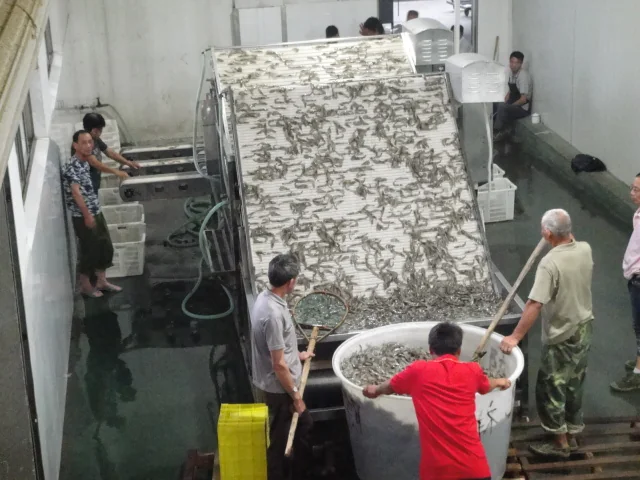
Why shrimp grading matters
Buyers often order shrimp by count size. More consistent shrimp sizes help achieve more uniform freezing, cooling and packing conditions. If very different sizes are processed together, residence time and final product quality can become less consistent.
A shrimp grading machine performs this separation mechanically and continuously. It sorts shrimp by body size through configured roller gaps rather than weighing every piece individually.
Working principle of a roller grader
Depending on the configuration, shrimp enter a receiving hopper, pre-washing section or water-assisted infeed at one end of the machine. The infeed section helps wash, spread and transfer the shrimp evenly so that the grading section is not overloaded.
The shrimp then move over pairs of long, rotating food-grade grading rollers. The rollers may be plastic/PVC or optional SUS304 stainless steel, depending on the machine configuration and hygiene requirements. The effective gaps are configured so that different body sizes drop through at different positions.
Smaller shrimp fall through earlier gaps, while larger shrimp travel further before reaching a suitable opening. Separate chutes or conveyors collect the different grades and move them to containers or the next processing stage.
Main components
A typical machine combines an infeed and pre-washing section, optional deep-cleaning section, grading rollers, gap adjustment, grade discharge conveyors and a control system. Drainage and access for cleaning are important because the machine operates with wet, perishable seafood.
The number of rollers, effective grading length and discharge outlets influences the final configuration. The standard material and electrical specification should be confirmed for the actual export project.
- Receiving, washing and spreading section
- Food-grade PVC or optional SUS304 rollers
- Adjustable grading gaps
- Separate grade discharge conveyors
- Electrical control and drainage structure
What determines the grade?
A roller grader sorts mainly by body size, including width and thickness, not by weighing each shrimp. Because body size and weight are related for shrimp of the same type, mechanical size grading can correspond well to commercial count sizes.
The result depends on roller-gap settings, effective grading length, the number of outlets and how evenly the shrimp are fed. Overloading or worn and misaligned rollers can reduce accuracy regardless of the machine model.
Raw shrimp and cooked shrimp
Raw and cooked shrimp have different product conditions and handling requirements. Raw shrimp may be graded after washing or before later processing. Cooked shrimp should normally be cooled first, typically through ambient-water pre-cooling followed by ice-water pre-cooling, before gentle grading, inspection and IQF freezing.
The final sequence depends on the product, cooking method and line design. In a cooked prawn line, the grader can be arranged with washing, cooking, cooling, selection, IQF freezing and packing equipment.
Capacity and information required for selection
Actual throughput depends on shrimp size, the number of grades, feed uniformity and the required grading accuracy. A machine should not be selected from a tons-per-hour figure alone. The supplier normally needs the shrimp species, raw or cooked condition, incoming size range, hourly capacity, grade count, power supply and factory layout.
Food-contact parts such as hoppers, chutes and conveyors should use the specified food-grade materials. The grading rollers may be plastic/PVC or optional SUS304 stainless steel depending on the configuration. Cleaning procedures and any specific hygiene certification should be confirmed for the actual model.
Need help matching the equipment?
Share your product, capacity and target process. Our team can suggest the next technical step.
Send an inquiry